
Tungsten Prices Under Pressure: The Importance of Tungsten Carbide in Hardfacing
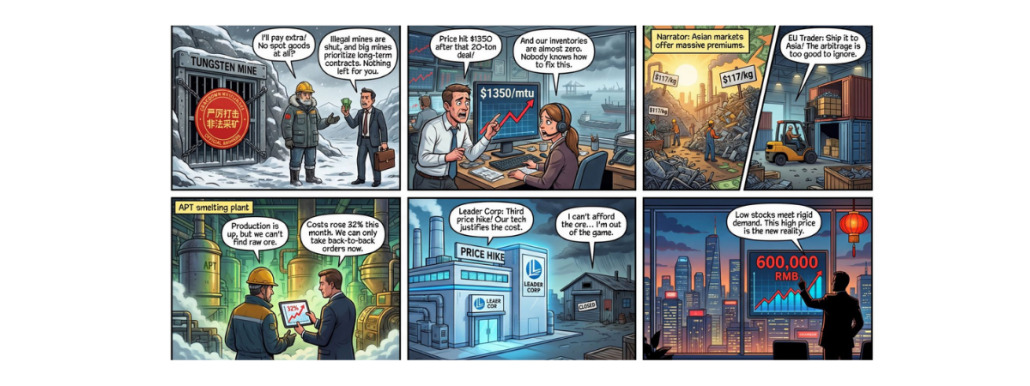
Over the past months, tungsten — as it is internationally known — has increased sharply in price. In China, the price of tungsten concentrate rose by more than 200% in 2025, and that movement is directly felt here as well. For companies operating heavily loaded ground-engaging parts, this is not abstract market news — it directly impacts every quotation and project calculation.
Tungsten carbide has long been an essential material in hardfacing for extreme abrasive applications. Especially now that prices are rising, it is important to understand why this material adds so much value, why it is difficult to replace, and what international price pressure means for your project.
Why Tungsten Carbide Is Difficult to Replace
Tungsten carbide has a hardness of 8.5 to 9 on the Mohs scale. For comparison, diamond scores a 10. This makes it highly resistant to severe abrasion caused by sand, rock and contamination.
In applications where components are in continuous abrasive contact with rough material, tungsten carbide retains its shape and protective function significantly longer than steel or lighter carbides.
This property is crucial for wear parts that:
-
Are continuously loaded
-
Are not easy to replace
-
Directly impact output and machine availability
The added value of tungsten carbide is not just hardness — it is reliability under severe conditions. Where other materials quickly round off or lose functionality, tungsten carbide continues to protect against wear.
Why Substitution Is Often Not a Real Solution
Alternatives to tungsten carbide do exist, such as chromium-based solutions or harder steel grades. In less extreme abrasive conditions, these can perform adequately and sometimes offer economic advantages.
However, in practice, very few materials offer the same service life and reliability as tungsten carbide in severe abrasion. Substitution in such cases almost always results in shorter lifetime and more frequent replacement — leading to higher total costs over the full operating period.
This makes the choice for tungsten carbide not a luxury, but a way to manage risk and control long-term costs.
Tungsten Prices: What Happened in Recent Months
The uncomfortable reality: the tungsten market has been turned upside down.
At the beginning of 2025, tungsten concentrate traded around €280 per metric ton. By the end of the year, it had risen to over €600 — an increase of more than 200%. Ammonium paratungstate (APT), the intermediate material used to produce tungsten carbide, increased from approximately €335 per mtu to over €1,000 per mtu.
The causes are structural and reinforcing:
China Tightening Supply
China produces approximately 82% of the world’s tungsten. In December 2024, new export controls were introduced on strategic raw materials, including tungsten. This is not coincidental: tungsten is widely used in military applications such as armor plating and projectiles. The US and Europe are attempting to secure alternative sources, but opening new mines takes years.
Reduced Mine Output
Chinese tungsten mines face declining ore quality and stricter environmental regulations. In Vietnam, output from the Nui Phao mine — one of the largest globally — dropped by 30% in a single quarter due to environmental audits. Russia, the third-largest producer, has also reduced supply amid geopolitical tensions.
Growing Demand
At the same time, demand continues to increase. Tungsten is not only used in traditional sectors such as mining and oil & gas, but also in battery production for electric vehicles, precision tooling for solar panels and semiconductors. The military sector is building stockpiles due to supply concerns — in May 2025, the Pentagon reported that its stock of armor-piercing munitions would last only 90 days.
Geopolitical Tension
In August 2024, the United States imposed a 25% import tariff on Chinese tungsten. Europe is attempting diversification through older mines in Spain and Portugal, but these are not yet operating at full capacity. South Korea’s Sangdong mine is coming online, but will not deliver substantial volumes until 2026.
The result is a perfect storm of constrained supply and rising demand — reflected directly in market pricing.
International Price Pressure: This Affects Everyone
Recent tungsten carbide price developments are driven by structural global factors. Production is highly concentrated, while demand is rising across multiple sectors including heavy industry, precision tooling, electrification and defense. Geopolitical tensions and trade restrictions amplify this dynamic.
It is important to understand: this is a global market.
Whether hardfacing is performed in Europe, the United States or Asia — tungsten carbide comes from the same international supply chain and trades at the same market-based prices. Lower labor costs or alternative locations do not change the underlying raw material price. There is no inexpensive detour.
Everyone working with tungsten faces this reality.
What Does This Mean for You?
In simple terms: raw material costs for hardfacing solutions have increased significantly. Tungsten carbide grit represents a substantial portion of material costs, and its price moves directly with global markets. We feel this — and so will you.
Due to this volatility, fixed annual pricing is no longer realistic. We work with flexible pricing structures that follow market developments and communicate significant changes proactively. This prevents surprises and allows forward planning. An honest conversation today is better than an unpleasant surprise in three months.
We fully recognize that we are in this together with our customers. While we cannot influence the global market, we can manage its impact by:
-
Carefully evaluating where tungsten carbide is truly necessary
-
Testing alternatives where technically justified
-
Minimizing downtime and output loss through extended service life
The Real Cost: More Than Just Material
A cheaper hardfacing layer that requires replacement after two weeks ultimately costs far more than a higher-quality solution that lasts five times longer — even if the initial purchase price is higher.
Let’s look at it practically.
Suppose hardfacing costs have increased by 30% compared to last year. That is significant. But what are the alternatives?
Option 1: Use a Cheaper Overlay
If it fails 3–5 times faster, you are not paying 30% more — you are replacing parts four times as often. On an annual basis, total cost increases substantially.
Option 2: Accept More Frequent Replacement
Every time a ground-engaging part is replaced, you incur:
-
The cost of the component
-
Labor for replacement
-
Machine downtime (€500–1,500 per hour in lost production)
-
Reduced daily output and lost revenue
Downtime and productivity loss are often 5–10 times more expensive than the material itself. If cheaper hardfacing requires replacement twice per month instead of once per quarter, the additional labor and lost production can quickly amount to tens of thousands of euros per year.
Option 3: Choose the Right Quality
Tungsten carbide is not inexpensive, but it remains the most cost-effective solution for severely loaded applications. Downtime costs money. Replacement parts cost money. Every interruption in production costs money — and those costs typically outweigh a 30% increase in material pricing.
Let’s Discuss Your Situation
Do you operate ground-engaging parts that fail continuously? Or are you planning a major project and want to calculate wear-related costs in advance?
Early alignment pays off. Together, we can assess:
-
Which hardfacing solution best suits your specific application
-
How to minimize downtime through extended service life
-
The business case of tungsten carbide versus lower-cost alternatives
-
Smart planning around material usage and inventory
No obligation, no sales pressure — just a technical discussion about what makes sense in your situation.
Call or email us, and let’s address your wear challenges before they become operational problems.
