Why wear resistance does not start with hardness, but with the matrix
Anyone dealing with wear will eventually arrive at the same reflex:
it needs to be harder.
Harder materials. Harder layers. Harder solutions.
On paper, that makes sense. Hardness is directly linked to resistance against abrasive wear.
And yet, in practice, you see something different.
The hardest layers often fail first.
Where it goes wrong
Wear is rarely a purely abrasive problem. In many applications, you’re dealing with a combination of loads:
-
abrasive particles
-
impact
-
fluctuating forces
-
localized stress buildup
A material optimized purely for hardness often lacks the toughness to handle these conditions.
The result:
-
cracking of the layer
-
material detachment
-
accelerated degradation
Not because the material isn’t hard enough, but because the system is out of balance.
What actually happens in a wear layer
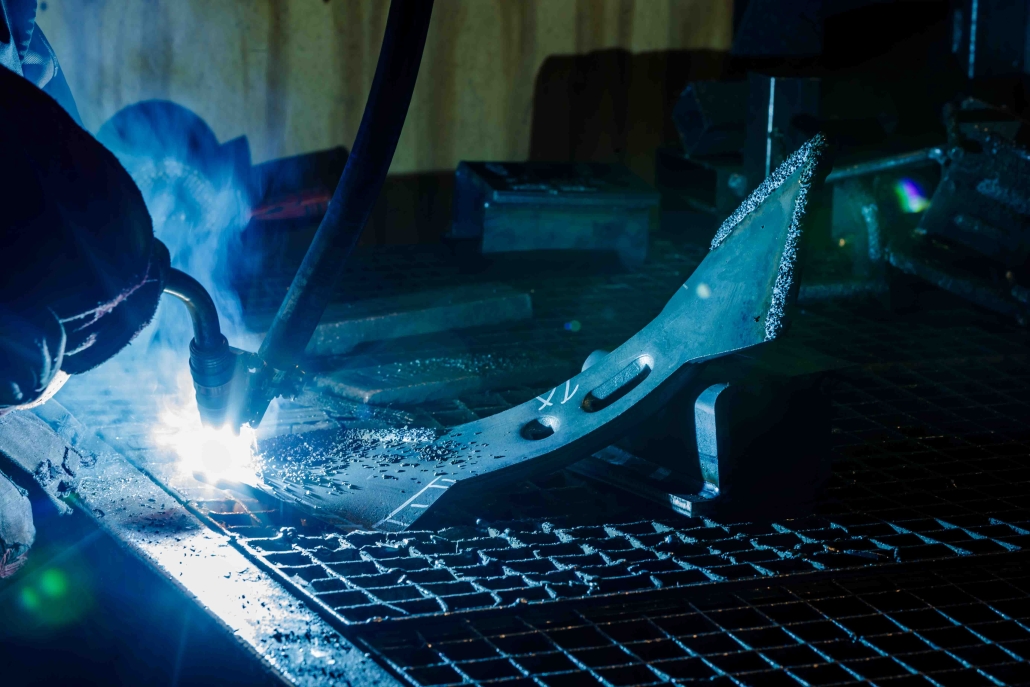
When applying a wear layer through welding, a molten pool is created. In that pool, three components come together:
-
the base material
-
the weld wire
-
the additive material (such as carbides)
Together, they form the matrix.
That matrix is not a byproduct of the process.
It is the load-bearing system of the wear layer.
The role of carbides
Carbides — such as tungsten carbide or titanium carbide — are extremely hard and provide the primary resistance to wear.
But they do not function independently.
During the process, something important happens:
-
part of the carbides (partially) dissolve into the matrix
-
part remains as solid particles embedded in the layer
This combination is what makes a wear layer effective. The embedded carbides take on the wear, while the matrix positions and protects them.
But that’s also where the risk lies.
Why carbides fail
Carbides are hard, but also brittle.
If the matrix is not properly engineered, two scenarios occur:
1. The matrix is too soft
The matrix wears away under load, causing the carbides to lose support and eventually disappear from the layer.
2. The matrix is too hard and brittle
The matrix cannot absorb impact, cracks under stress, and carbides break out of the layer.
In both cases, you lose the very component that was supposed to provide wear resistance.
This is often seen in practice: layers that perform well initially, but quickly lose their protective function.
The importance of carbide distribution
Beyond matrix composition, the way carbides are introduced plays a crucial role.
Carbide distribution determines:
-
how evenly carbides are spread throughout the layer
-
the density of hard phases
-
the interaction between matrix and carbide
An uneven distribution creates weak zones.
Too little carbide results in insufficient protection.
Too much, or poorly distributed carbide, can introduce internal stresses.
It’s not just about what you add — but how you add it.
Wear resistance as system behavior
Wear resistance is not a property of a single material.
It is the result of interaction:
-
between hard and tough phases
-
between load and material behavior
-
between layer design and application
That is why a single standard solution rarely works everywhere.
A wear layer that performs perfectly in an abrasive environment may fail as soon as impact becomes dominant — and vice versa.
Why “harder” is not the solution
The tendency to move toward ever harder materials is understandable, but limited.
Without the right matrix:
-
carbides lose their effectiveness
-
internal stresses increase
-
service life decreases
The solution is not maximum hardness, but the right balance between hardness and toughness.
In conclusion
To truly understand wear, you have to look beyond material selection alone.
The question is not:
“How do we make it as hard as possible?”
But:
“How do we make materials work together under load?”
That is where the design of an effective wear layer begins — in the matrix.
